
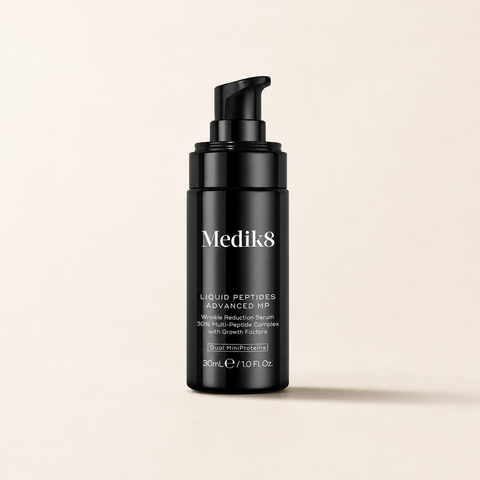
Dr Max’s view

Why I chose it

Peptides that are applied on the skin are relatively new and as a general rule of thumb I’m slightly sceptical about new things. That being said, there is no smoke without fire and we are starting to see more than a few sparks around peptides. Studies are starting to show good improvement in skin quality with certain high quality peptides. That’s where this product shines, they have thrown loads of effective and evidence-based peptides into the mix as well as their own proprietary MiniProtein™.

Dr Max GreenfieldMBBS, BSc, MRCS(Eng)

Routine placement

Where this fits

A broad guide to where this sits, without assuming how many steps your routine has.

Comes afterCleansing and any Vitamin C or antioxidant
This product Medik8 Liquid Peptides Advanced MP
Comes beforeMoisturiser and SPF
Comes afterCleansing and any lighter leave-on products
This product Medik8 Liquid Peptides Advanced MP
Comes beforeRetinoid or moisturiser
Curate your full skincare routine
How to introduce it

Medik8 Liquid Peptides Advanced MP is very well tolerated and is unlikely to cause any sensitivity or irritation. As such, it’s something that you can use in the morning, evening or both. 

Where in your routine you apply this depends on what other product you are currently using. Have a look at the matrix above to see when is best for you. 

1-1.5 pumps will cover your face and 2 pumps for your face and neck. 

Your retinoid and Vitamin C should always take priority over peptides so if you find that your routine is a bit busy then use the peptides on the mornings or evenings where you have more time rather than sacrificing anything in the Core routine.

Guidance continues after purchase. We can help you introduce, simplify or adjust this product.

Inside the formula

The ingredients that make this special

A closer look at the ingredients doing the most meaningful work in this formula—and what the evidence can reasonably tell us.

Dual MiniProteins™

A proprietary protein complex designed to help support skin firmness and elasticity.

Read the clinical context

Dual MiniProteins™ is a trademarked ingredient blend developed to help improve the appearance of fine lines and skin laxity. As a branded complex, most of the available data comes from manufacturer-led laboratory and small clinical studies. These suggest potential benefits for supporting collagen structure and improving skin texture with consistent use. However, independent large-scale clinical evidence is limited, so claims around lifting or firming should be viewed as supportive rather than transformative. It is typically included in formulations targeting early signs of ageing and loss of elasticity.

Matrixyl 3000™

A peptide complex designed to help improve the appearance of fine lines and skin firmness.

Read the clinical context

Matrixyl 3000™ is a patented blend of two peptides (palmitoyl tripeptide-1 and palmitoyl tetrapeptide-7) developed to help support collagen production and reduce visible signs of ageing. Small clinical studies, largely manufacturer-sponsored, suggest it may help improve wrinkle depth and skin texture with consistent use. While the underlying peptide technology is biologically plausible and generally well tolerated, independent large-scale trials are limited. Results are typically gradual and best seen as part of a broader, well-formulated skincare routine.

Copper Peptides

A peptide complex that helps support skin repair and firmness.

Read the clinical context

Copper peptides are short chains of amino acids bound to copper, a trace element involved in skin repair processes. Laboratory and early clinical studies suggest they may help support collagen production, improve skin elasticity and promote wound healing. However, much of the evidence in cosmetic skincare is based on small or manufacturer-led studies, and results can vary depending on formulation and concentration. They are generally well tolerated and often included in products aimed at supporting skin resilience and recovery, particularly in mature or environmentally stressed skin.

View the complete ingredients list

Aqua (Water), Glycerin, Dimethicone, Dimethyl Isosorbide, Butylene Glycol, Undecane, Arginine, Inulin, Microcrystalline Cellulose, Ceteareth-20, Tridecane, Tocopherol, Hydroxyacetophenone, Sodium Hyaluronate, Palmitoyl Tripeptide-38, Panthenol, Caprylic/Capric Triglyceride, Palmitoyl Tripeptide-5, Polyacrylate Crosspolymer-6, Palmitoyl Tripeptide-1, Pullulan, Tetrapeptide-21, Palmitoyl Tetrapeptide-10, Palmitoyl Tetrapeptide-7, Ammonium Polyacryloyldimethyl Taurate, Glyceryl Linoleate, Acetyl Hexapeptide-8, Pentapeptide-18, Oligopeptide-1, Arginine/Lysine Polypeptide, Sucrose Palmitate, Cetyl Palmitate, Phenoxyethanol, Ethylhexylglycerin, Carbomer, Copper Palmitoyl Heptapeptide-14, Heptapeptide-15 Palmitate, Benzotriazolyl Dodecyl P-Cresol, Polysorbate 80, Sorbitan Stearate, Polysorbate 20, Carnosine, Sodium Metabisulfite, Dunaliella Salina Extract, Helianthus Annuus (Sunflower) Seed Oil, Hydroxypropyl Cyclodextrin, Dimethicone/Vinyl Dimethicone Crosspolymer, Sodium Benzoate, Hydrogenated Lecithin, Caprylyl Glycol, Pantolactone, Xanthan Gum, Disodium EDTA, T-Butyl Alcohol, Potassium Sorbate, Citric Acid, Glyceryl Caprylate, Lactic Acid/Glycolic Acid Copolymer, Polyvinyl Alcohol, Phenylpropanol.

The thinking behind the formula

More about Medik8

Medik8 develops and manufactures virtually all of its products at its ISO-certified innovation centre near London. Its in-house scientists focus on formulation, stability and ingredient delivery rather than following a trend simply because it is popular.

Crystal Retinal is a good example. Retinal is an effective but fragile molecule, so Medik8 uses encapsulation, a patented stabilising complex and protective packaging, alongside a ladder of strengths designed for measured progression.