
Dr Max’s view

Why I chose it

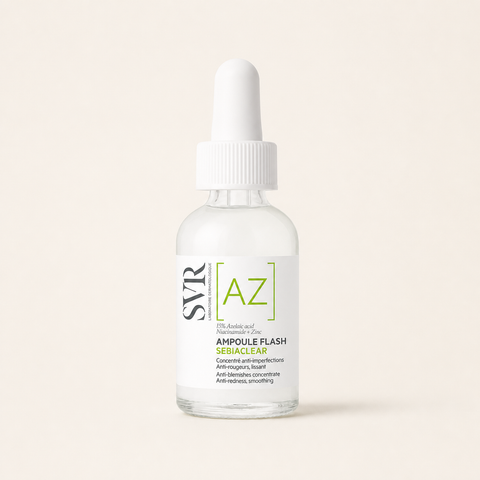
Azelaic acid is one of my favourite ingredients, not just for acne but also for more sensitive skin and rosacea. It has a really strong evidence-base and is used as a prescription medicine for both acne and rosacea. Having an effective, really easy to apply, well formulated serum that works with other skincare products whilst causing little-to-no sensitivity is rare and makes it worthy of The Curatory. From a price perspective, I appreciate that there are less expensive acne treatments out there but they tend to focus on single ingredients rather than the well balanced cocktail that SVR has formulated.

Dr Max GreenfieldMBBS, BSc, MRCS(Eng)

Routine placement

Where this fits

A broad guide to where this sits, without assuming how many steps your routine has.

Comes afterCleansing and any toner or mist
This product SVR Sebiaclear Ampoule [AZ] Flash
Comes beforeOther leave-on products and SPF
Comes afterCleansing and any toner or mist
This product SVR Sebiaclear Ampoule [AZ] Flash
Comes beforeOther leave-on products
Curate your full skincare routine
How to introduce it

As a serum this product is on the thinner side meaning that it should be applied early in your skincare routine usually after cleaning (and toning if this is in your routine). It can be applied in both the morning and evening every day but to start it’s worth just using once a day in the evening in case your skin feels a little sensitive with new ingredients.

Invert the bottle a few times before placing 5-6 drops with the pipette into the palm of your non-dominant hand. With your dominant index/middle finger gently massage into your skin. It does smell a little strong when first applied but improves very quickly.

Guidance continues after purchase. We can help you introduce, simplify or adjust this product.

Inside the formula

The ingredients that make this special

A closer look at the ingredients doing the most meaningful work in this formula—and what the evidence can reasonably tell us.

Azelaic Acid

A multi-functional ingredient that helps improve breakouts, redness and uneven pigmentation.

Read the clinical context

Azelaic Acid is a naturally derived ingredient with good clinical evidence supporting its use for acne-prone and redness-prone skin. It helps to calm inflammation, reduce clogged pores and slow down excess pigment production, making it useful for both breakouts and dark spots. Prescription strengths tend to work more quickly, while cosmetic strengths offer gradual improvement with consistent use. It is generally well tolerated and suitable for sensitive or reactive skin types.

Salicylic acid

An exfoliating BHA that helps to increase skin cell turnover and support the treatment of acne.

Read the clinical context

Salicylic acid is a betahydroxy acid (BHA) that has a number of benefits, particularly for acne-prone skin. Its most well studied benefit is as a chemical exfoliant, particularly when with a lower pH. This increases how quickly skin cells turnover, bringing healthy skin cells to the surface. It’s also a hydrophobic or oil-loving molecule so helps to break down excess sebum and unclog the oxidised sebum trapped in pores (black heads). If that weren’t enough, salicylic acid is also anti-inflammatory and helps to calm redness associated with acne.

Niacinamide

Antioxidant and anti-inflammatory that helps to improve skin barrier and reduce pigmentation and redness.

Read the clinical context

Niacinamide is a jack of all trades ingredient. Most of its evidence base is for improving pigmentation but also acts as an anti-oxidant ingredient helping to reduce redness and inflammation as well as supporting skin barrier function.

Zinc Gluconate

A mineral ingredient that helps support oil balance and calm blemish-prone skin.

Read the clinical context

Zinc Gluconate is a bioavailable form of zinc used in skincare for its soothing and sebum-regulating properties. There is moderate evidence, including small clinical studies, suggesting topical zinc may help reduce excess oil and support skin prone to breakouts. Laboratory research also supports its anti-inflammatory and mild antimicrobial activity. While it is not a standalone treatment for acne, it is generally well tolerated and commonly included in formulations designed to help balance and calm oily or reactive skin.

View the complete ingredients list

Aqua/Water/Eau, Azelaic Acid, Glycerin, Isopropyl Alcohol, Isopentyldiol, Niacinamide, Zinc Gluconate, Dicaprylyl Ether, Salicylic Acid, Parfum (Fragrance), Pentylene Glycol, Sodium Hydroxide, Microcrystalline Cellulose, 1,2-Hexanediol, Caprylyl Glycol, Sphingomonas Ferment Extract, Cellulose Gum, Tocopherol.

The thinking behind the formula

More about SVR

Laboratoire SVR has developed dermatological skincare since 1962, with ranges designed for different skin needs including sensitive and reactive skin. Its Sensifine line focuses on short, carefully considered formulas for skin that is easily unsettled.

Sensifine AR Micellar Water uses mild cleansing agents and niacinamide in a fragrance-free formula intended for the face, eyes and lips.